Social networks are getting high

Not that I don’t like social networks, but I see no use for them in my personal life. I use Twitter for business reasons mainly, like advertising my upcoming training “JavaScript for Java Developers“, which doesn’t prevent me from posting a photo of two salmon heads that I was about to use for fish soup. Java developers eat fish too, and these fish heads could start a small talk with someone, who could decide to enroll in my training later.

I have an account on LinkedIn, which, hopefully, one day will bring me some business opportunity other than these annoying emails “I want to add you to my professional network”. I have an account on Facebook (everybody does), but my main activity there is denying requests to become friends (is this wrong? did they bring business to anyone?).

As any citizen of an industrialized country where people don’t need to hunt for food, I live in two worlds – virtual and real. The question is, “Do I need to merge these worlds or should keep them apart?” Take a look at this image.

See a handsome face on 15F? You guessed it right – it’s me! No, I was not using Photoshop – everything happened naturally. I booked an airplane ticket with a European airline and got an email from them suggesting to pick a seat and use my FaceBook or LinkedIn account to identify myself, which I did. This is how my pretty face got into the seat 15F. The next question is if it was a smart or stupid thing to do? Initially, I selected 15F hoping that the flight won’t be fully booked, and no one will want to take the seat in the middle (15C), and I’ll have some extra room during my flight to Europe.

But now, after identifying myself, most likely some 300-pound LinedIn aficionado will take 15C on purpose even if we’re not connected just yet. No thank you very much. I’m not going to take chances. In the virtual world I can easily ignore annoying people, but being trapped with an unknown talkative facebooker for 8 hours doesn’t seem too appealing to me. Luckily, this airline let me delete my LinkedIn profile from the seat map, so I’m flying incognito, yay!

Update. Two weeks after I wrote this blog, I ran into an interesting TED talk by Sherry Turkle “Connected or being alone.” She found the right words explaining why I decided not to put mu face into that airplane: We want a controlled communication, which could be screwed up should I allow someone from the virtual world sit next to me.
Germany opens borders for programmers

Have you read today’s German version of Financial Times? I did. Not that I can read German, but you don’t have to – just copy/paste the text of this article to Google Translate’s left box. It’s smart enough to recognize that it’s in German. Pick your language in the “To:” dropdown and enjoy the news.

From now on, if you are software developer, your perspective employer doesn’t have to pay you 66 thousand Euros a year, but “only” 45 thousand. Given their tax laws, it’ll translate into two thousand euros a month after taxes. Who can Germany attract with this amount? India, Pakistan, Bangladesh, and China. Russia and Ukraine won’t bother. They can take home this much cash either officially after paying from 5 to 13% tax, or using what they call grey salary, where part of the pay is given in an envelope stuffed with long and green bills.

Some people will get excited by the fact that you can enter the country and spend 6 months there just looking for a job, but again, this won’t attract software developers from the Eastern Europe. Overall, Germany tries to take a step in the right direction, but five years down the road the may not be happy with the results.

Be Careful With Europcar

During the last fifteen years I’ve being spending at least one week a year vacationing in France. Love this country for their culture, traditions, gourmet food, great wine, great skiing, and friendly people. Once in a while I rent a car and drive there visiting all these nice little villages and chateaux.

In January, I rented a car for 7 days from Europcar in France. The price was very decent: around 430 Euros for a good midsize car. The rent was prepaid in advance, but at the rental counter I was asked to provide them my credit card for accidentals, besides, I was warned that there will be small additional licensing/ecologic fees. I also asked the Europcar lady if I could purchase a GPS device, and she sold me one explaining that it’ll costs me 10 euro a day, but not more than 30 euros total. We got the small device and our trip exploring Provence begun. I’ve been also warned for additional 39 euros charge for the second driver.

After driving a couple of miles I noticed that our car has an excellent built-in GPS system. The first question was, “Why they sold us a second GPS device”? Three days into our journey we called Europcar asking not to charge us these 30 euros because the car was equipped with the GPS in the first place. They said, “We’ll see what we can do”.

The trip was over, Provence was great as expected, and, in about a month, I got a letter from Europcar stating that they charged my credit car for another 425 euros. The letter conveniently included the breakdown of the charges. I’ll just mention that ecology/licensing contributed only about 10% of that charge. They also charged me 70 euros for using the GPS for 7 days plus other fees.

Quick call to Europcar produced “Sorry, there is nothing we can do about the GPS charges”. Quick call to my credit card here in the US: “No problem, we’re opening the dispute with Eropcar. But first, we’ll refund you full amount.” God bless America! I said, “I’m not planning to dispute all the charges”, but for this particular credit card company was easier to dispute all amount so the vendor can start discussing details.

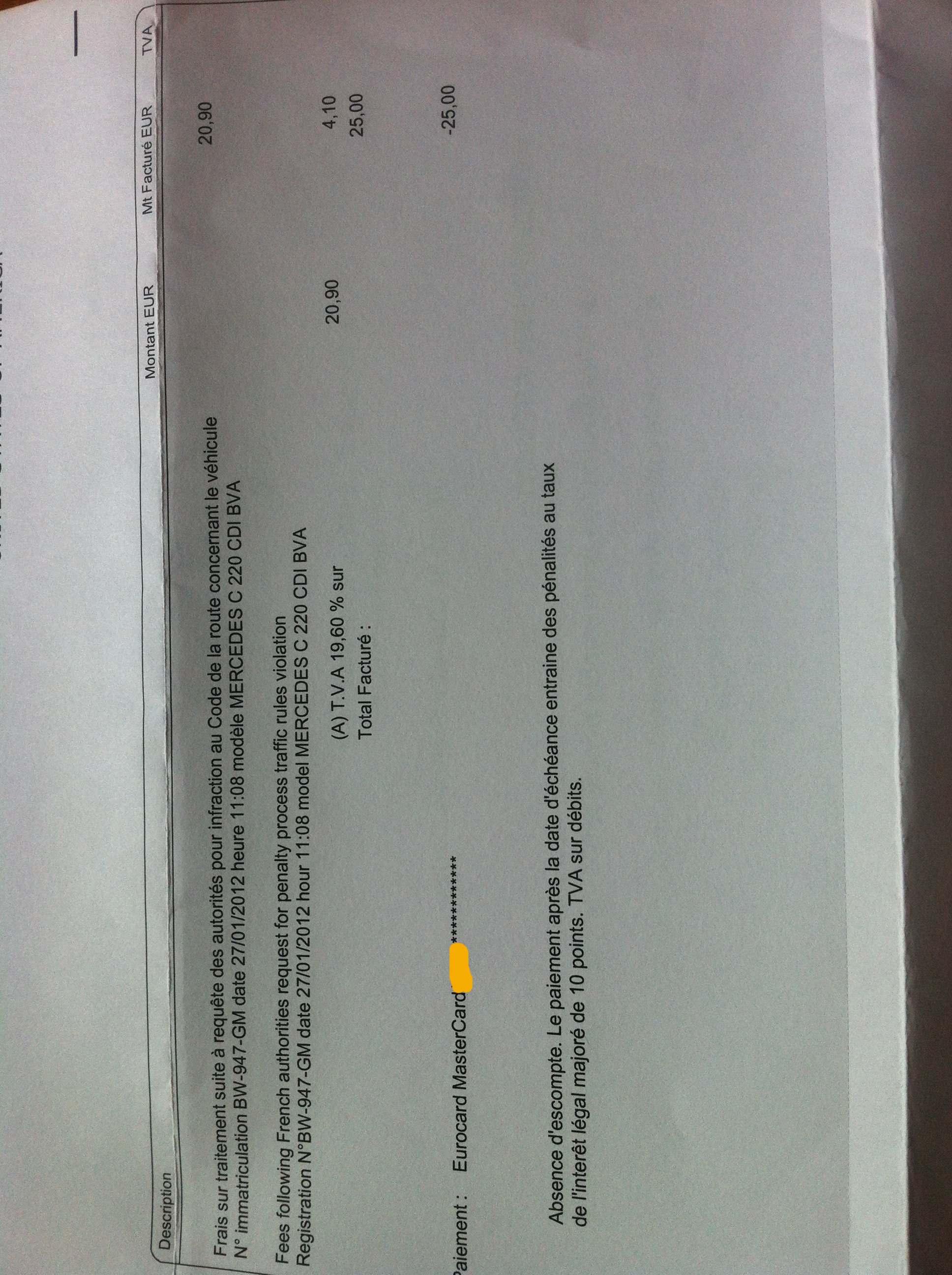
A week later, I’ve received two more letters from Eropcar notifying me that I made two traffic violations and my card was charged 25 euros for each one. I was never pulled over in France, but hey, there is no such thing as a saint driver. I might have been caught by one of the hidden video cameras while speeding or making an illegal turn. This happened to me in the past in the USA, but I’d always received a letter with camera photos showing my car in the midst of breaking the rules.
Europcar didn’t bother giving me any details other than date and time. The brief explanation reads “Fees following French authorities request for penalty process traffic rules violation. License plate, date, and time”.

I made another call to my credit card company disputing these 50 euros too. Let the conversation with Eropcar begin, and I’ll pay whatever I deserve to pay. But it seems that the dialog ain’t gonna happen. The new letter from Europcar simply states “Your credit house rejects our transaction” and if I’m not going to pay, the case goes to legal department and you’ll be placed “on the watch list which will prevent you from renting a car in all Europcar’s network”.

Oh well, I’ll wait until Europcar decides to talk to me explaining the validity of each and every charge. Meanwhile, I’ve placed them on the list of car rental companies to never rent from. I’m sending the link to this blog right to the service department of Europcar – if they want to talk, my phone number is on the record.

Backs

People take pictures of people. Saying “Cheese” or “Sex” immediately puts an artificial smile on the other person’s face. Taking photos of people from the front is so 19-th Century. You gotta be a professional photographer to make a realistic portrait.

Last summer, while walking to my workplace in Manhattan, I started to pay attention to the backs of people’s moving in the same direction. Most of the backs were boring, but sometimes, I saw a back that made me wonder what’s the face of this person looked like? Typically, the face was less interesting to watch than the back. So I decided taking pictures of selected backs without even bothering looking at their faces.

Check them out slowly. Don’t critique the quality of the photos – I’ve been using iPhone while walking. Just try to imagine how the front-ends of these people look like.

Thoughts While Watching Apple’s New iPad Presentation

I like Apple products. Our family of four owns nine of their devices. I’ll always respect Steve Jobs for being a visionary and improving our taste. And I’ve enjoyed his keynotes a lot.

Yesterday, I was watching Tim Cook’s presentation of the new iPad. I saw a gray-haired fit man in black moving on stage passionately talking about his company’s great products. The audience cheered him with applauds. It almost felt like watching Steve Jobs.

It’s clear that Tim Cook spent substantial time on improving his presentation skills and rehearsing his talk. Of course, he’s not as good as Steve Jobs just yet. He needed to add more drama to the talk and shouldn’t have revealed the iPad that soon. Of course, I missed that famous Steve’s “And one more thing…”

But overall, Tim Cook did great on stage. The company does great. As bad as it sounds, people will forget Steve Jobs soon. The crowd needs to be entertained and get fed with new cool toys. As long as Mr. Cook (and his team) will deliver, the crowd will admire him.

Le Roi est mort. Vive le Roi! The king’s dead. Long live the king!

Hiring Teams of Offshore Software Developers

Over the last five years one of my responsibilities was interviewing and hiring software developers and many of them were physically located overseas. In this post I’d like to share with you my thoughts (and get your feedback) on one of the aspects for offshore hiring: pros and cons of hiring individuals vs. teams.

Our company, has people located in the USA (East Cost) and Eastern Europe. We have a number of clients here in the USA, and some of our consultants work on sites. Sometimes a team of our developers works for the clients remotely. In some cases we provide not only a remote developers to augment the client’s team, but also a senior software architect and/or a manager too.
Our consultants works for us for years, we trust them, and they have a steady stream of work. But once in a while we have to quickly ramp up the team. For example, a new customer needs a team of five remote developers, and they need them now. We are a small software boutique and don’t have a long bench of people sitting without of work. So where to find talent quickly? In such cases we are facing the hiring dilemma:

a) we can contact to our long time partners – large offshore companies – and subcontract their developers.
b) we can start some serious interviewing process trying to pick the right talent in the open market of freelancers.

The first option is more expensive, but more preferable cause we worked with these partners for a while, the quality of their resources is typically higher, they are collocated in the same building, and the chances of losing a developer in the middle of the project are slim.

But in both cases we are getting offers to hire a team rather than individual developers. If you are looking for five developers, an offer to hire a team of five sounds very lucrative, but we never do this. Yes, having a group of people that already worked on several projects is great, but the skill-set and experience of each team member varies. But your offshore vendor charges a flat fee for each developer.

I always reject such offers. I want to interview each and every person from an existing team to make sure that I’m not getting a team of four C-players and one A-player. I’d rather work with five B-players than with one star with an entourage. This strategy allowed us to maintain a bit higher rates for our services.

Interestingly enough, our smaller size clients or startups understand the advantages of not having weak people in the vendor’s team, but thus is not the case with large corporate customers. They want to minimize the hourly rate. Period. The hiring manager won’t fight to get a particular vendor for more money just because they’re more experienced – this is not something you can easily measure. But the hourly rates are easy to compare. I remember a corporate manager who asked me, “Can’t you hire developers willing to work for a bowl of rice?” I can’t, and I won’t.

What’s your take on this? Does your firm has a list of approved vendors and you are forced to hire teams or are allowed to build them?