I Feel Bad

Yesterday, I made a trip to Manhattan on some family matters. While walking by the the Seaport in the lower Manhattan, I noticed a group of asian guys doing back massage to the tourists right on the street. I’m sure you saw these special chairs where you kinda sitting on your knees while they work on your back.  Before, I never trusted my precious body to unknown people unless they were licensed medical doctors or were working in SPA in luxury hotels.

But about a week I started feeling some pain in the lower back somewhere above the kidney. First, I thought it was a minor muscle  pain that should go away in a day or two. But it didn’t. Then I started to think that it might have been something more serios inside. So I decided to take my chances and give myself to the hand of this street masseuse who barely spoke any English. The deal was simple – $10 for 10 minutes or $20 for 20. I never saved on investing into myself and have chosen the more expensive version of this treatment.  My logic was simple – the chances that he’ll make my pain worse are slim. If the pain won’t go away, I’ll make an appointment with my family physician.

Twenty minutes later, the massage was over, I gave the guy $20 and left. Right after the massage it was not clear if it helped with my issue. But guess what, the day after I can confirm that the pain was gone! Now I feel bad. Why I didn’t tipped the guy?  It is bad. I’m not sure when I’m going to be there again – it’s about 50 miles from where I live. I can’t send a check to a guy that I saw on the street and don’t know anything about. That’s why I decided to write this blog.

If you happened to be in that area and need a massage, go for it. There are three men and a woman massaging people. Mine was a short guy wearing a blue shirt and earphones. The next time I’ll be tipping someone, I’ll double the tips too.

Sorry, man!

What Project Managers Can Learn From Airport Security

On average, I pass the airport security four times a month either on business or as a tourist. Over the years I became a living proof that Pavlov’s finding about conditioned reflexes were correct.
When I see an airport, I start pulling off my belt, taking off my shoes, and my hands are unzipping my laptop bag. Everyone knows that keeping the notebook in a separate tray while passing this X-Ray machine makes your flight safer. Nobody knows why though.

Last week, the New York Times published an article titled “The Mystery of the Flying Laptop”, where Matt Ritchel tried to find the reason WHY you have to pull the laptop from your bag, but tablets or smartphones can sit inside… in some airports. He was talking to different people from the Transportation Security Administration (a.k.a. TSA), but no one seemed to know the answer.

Finally, one security expert offered the following explanation: “…the laptop rule is about appearances, giving people a sense that something is being done to protect them. “Security theater,” he called it.” And this makes sense to me. On the same token, just seeing policemen on the streets may stop some criminals from trying bad things.

And what all this has to do with project management? It’s elementary, Watson! Some of the project managers trust their employees completely (and in many cases for good reasons), and don’t even bother checking on the status of their current assignments. Sometimes they get surprised that John, a great software developer, was working for three weeks on the assignment, got carried away and delivered not exactly what you’ve expected. Sure enough, John will fix this little issue – he just needs a couple of more days for this.
This could have been prevented if the manager would be checking on the status of the project every couple of days. “Management theater”, kind of. Not that the manager would have helped the experienced and trustworthy John in creating that software piece, but just the mere fact that “somebody cares and will ask about the status” may prevent John from moving sideways and will help in accomplishing the assignment in a timely fashion and to the specification.
So don’t underestimate this management theater. Talk to people who work for you regardless if they have an excellent track record in delivering great results in the past. Do it respectfully, but do it regularly.

Our aircraft has landed and pulled over to the gate a minute ago. I’m about to witness a demo another Pavlov Dog’s reflex – right after that beep sound everyone will stand up to open the overhead compartment… just to spend the next 5 minutes standing uncomfortably in a tight space between the bags instead of continuing sitting in their seats. There’s nothing you can do about it – reflexes rules!

A Life Saving Egg Hack

Sometimes I eat chicken eggs in the morning. I boil two eggs for six minutes. My wife is not too happy with the fact that I’m doing this in an old-fashioned way. Yes, I simply bring the water to the boiling point and then put there as many eggs as I want. But my wife has a dozen different kitchen devices, and one of them is specifically for boiling eggs. It looks like this:

The first problem with this device is that it comes with a plastic measuring container, which used to have these special marks for the right amount of water depending on the number of eggs you want to boil. These marks disappeared over time and you can’t me sure if you’re gonna get the soft or hard boiled eggs.This egg machine has another annoying thing – you have to make a hole with a special needle in the raw eggs. But the grandma’s method always works fine. I just need to remember one number – 6 minutes regardless of the number of eggs you’re boiling. No holes, no nothing.

Here’s my life saving egg hack (c).

After the eggs are cooked, I put them in a special egg-holder for large eggs. You may be surprised, but chicken continue producing eggs of different sizes, and if an egg is small, it slides down to the bottom of the egg holder screwing my entire breakfast experience. If this bothers you too, here’s the trick.

Important: you must eat the larger egg first. After you’re done with the first one, keep its shell inside the container, and put the smaller egg inside the used shell as shown in the photo below. Yep, it’s that simple.

If this blog has ignited your interest in eggs, I can recommend you this wikipedia article for further studying of the subject. Enjoy your eggs!

Social networks are getting high

Not that I don’t like social networks, but I see no use for them in my personal life. I use Twitter for business reasons mainly, like advertising my upcoming training “JavaScript for Java Developers“, which doesn’t prevent me from posting a photo of two salmon heads that I was about to use for fish soup. Java developers eat fish too, and these fish heads could start a small talk with someone, who could decide to enroll in my training later.

I have an account on LinkedIn, which, hopefully, one day will bring me some business opportunity other than these annoying emails “I want to add you to my professional network”. I have an account on Facebook (everybody does), but my main activity there is denying requests to become friends (is this wrong? did they bring business to anyone?).

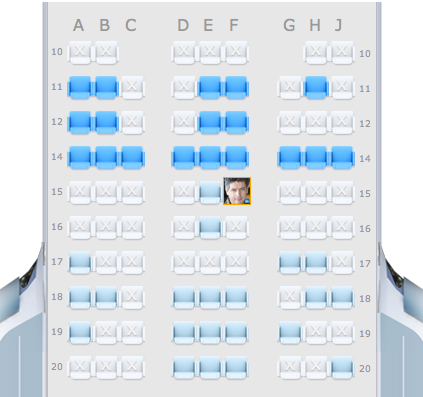
As any citizen of an industrialized country where people don’t need to hunt for food, I live in two worlds – virtual and real. The question is, “Do I need to merge these worlds or should keep them apart?” Take a look at this image.

See a handsome face on 15F? You guessed it right – it’s me! No, I was not using Photoshop – everything happened naturally. I booked an airplane ticket with a European airline and got an email from them suggesting to pick a seat and use my FaceBook or LinkedIn account to identify myself, which I did. This is how my pretty face got into the seat 15F. The next question is if it was a smart or stupid thing to do? Initially, I selected 15F hoping that the flight won’t be fully booked, and no one will want to take the seat in the middle (15C), and I’ll have some extra room during my flight to Europe.

But now, after identifying myself, most likely some 300-pound LinedIn aficionado will take 15C on purpose even if we’re not connected just yet. No thank you very much. I’m not going to take chances. In the virtual world I can easily ignore annoying people, but being trapped with an unknown talkative facebooker for 8 hours doesn’t seem too appealing to me. Luckily, this airline let me delete my LinkedIn profile from the seat map, so I’m flying incognito, yay!

Update. Two weeks after I wrote this blog, I ran into an interesting TED talk by Sherry Turkle “Connected or being alone.” She found the right words explaining why I decided not to put mu face into that airplane: We want a controlled communication, which could be screwed up should I allow someone from the virtual world sit next to me.

Germany opens borders for programmers

Have you read today’s German version of Financial Times? I did. Not that I can read German, but you don’t have to – just copy/paste the text of this article to Google Translate’s left box. It’s smart enough to recognize that it’s in German. Pick your language in the “To:” dropdown and enjoy the news.

From now on, if you are software developer, your perspective employer doesn’t have to pay you 66 thousand Euros a year, but “only” 45 thousand. Given their tax laws, it’ll translate into two thousand euros a month after taxes. Who can Germany attract with this amount? India, Pakistan, Bangladesh, and China. Russia and Ukraine won’t bother. They can take home this much cash either officially after paying from 5 to 13% tax, or using what they call grey salary, where part of the pay is given in an envelope stuffed with long and green bills.

Some people will get excited by the fact that you can enter the country and spend 6 months there just looking for a job, but again, this won’t attract software developers from the Eastern Europe. Overall, Germany tries to take a step in the right direction, but five years down the road the may not be happy with the results.

Backs

People take pictures of people. Saying “Cheese” or “Sex” immediately puts an artificial smile on the other person’s face. Taking photos of people from the front is so 19-th Century. You gotta be a professional photographer to make a realistic portrait.

Last summer, while walking to my workplace in Manhattan, I started to pay attention to the backs of people’s moving in the same direction. Most of the backs were boring, but sometimes, I saw a back that made me wonder what’s the face of this person looked like? Typically, the face was less interesting to watch than the back. So I decided taking pictures of selected backs without even bothering looking at their faces.

Check them out slowly. Don’t critique the quality of the photos – I’ve been using iPhone while walking. Just try to imagine how the front-ends of these people look like.

Creating a Snapshot of the World With Google

Last week I published a blog about using Google for getting quick help with my English grammar. One of the readers recommended me a commercial program for that. Why would I pay for the software, if I could get the answer I need for free within 2 sec? Buying specialized software would make sense if I’d be just starting learning English. But in my case Google is all I need. Besides, I have a degree in applied math and trust the law of large numbers.

I’m sure Google has tons of non-traditional uses. Don’t forget that Google started from Larry Page’s attempts to rank Internet pages. He didn’t plan to create a search engine. So let’s think out of the box and come up with other unusual uses of Google.
Here’s what I can offer you today: let’s create today’s snapshot of your world with Google and the alphabet in your language. Here’s what you should do: just type each letter from your alphabet noting down each word that comes out first, second, and third. This is my result with the English alphabet:

A – Amazon.com, AOL, Apple
B – Best Buy, Bank of America, Blumingdales
C – Craigslist, Chase, CNN
D – Dictionary, Dominos, Delta
E – ESPN, eBay, Expedia
F – Facebook, fandango, Food Network
G – Google, Gmail, Google translate
H – Hotmail, Hulu, Home Depot
J – Jetblue, J.C.Penny, J. Crew
K – Kayak, Kohls, Kindle
L – LIRR, LinkedIn, Lord and Taylor
M – Mapquest, Macy’s, maps
N – Netflix, Nordstrom, nj transit
O – Old Navy, optonline.net, occupy wall street
P – Pandora, pinterest, Paypal
R – Redbox, rate my professor, restoration hardware
S – Skype, Staples, Sears
T – Target, translate, Toys’R’Us
U – USPS, UPS, Urban Dictionary
V – Verizon, Victoria Secret, Verizon FIOS
X – Xbox, X Factor, Xbox Live
Y – Youtube, Yahoo, Yahoo mail
Z – Zappos, Zara, Zillow

Interesting, isn’t it? Who would have though that Craiglist is more popular than CNN… I’ve been running this experiment sitting at home in New Jersey, USA. This explains some location-related results like LIRR (Long Island Rail Road) or NJ Transit. So your mileage may vary even within the USA.

Google performs serious processing of their log files to create their picture of the world, and they have a lot of more brain and computer power than I do. But hey, don’t you want to play a statistician too? It’s better than killing time with Sudoku or Bud Light, isn’t it?

If you decide to repeat this experiment with your language alphabet, please post the comment here telling where did you run it from and copy/paste your results. Don’t you worry that the readers of my blog may not understand Italian or Greek – Google Translate will convert your result into whatever language they like, well, almost any language.

Learning English with Google

English is my second language, but the last 20 years I live in the USA and my English is fluent. I almost never have to refer to a dictionary. But blogging and book writing forces me to look for help once in a while – readers (a.k.a. angry birds) are quick to point fingers if someone uses THEIR language improperly. I’m not talking about spelling errors – any text editor has a spell checker. I’m talking about phrases and, especially, articles – “a” vs “the” vs no articles at all, which is the most difficult part to comprehend. The funny thing is that most of the Americans raised and born here can’t explain WHY you should use “a” or “the” in this particular context. They just know what to use and do it.

If you are an ESL-person like myself, I’d like to share with you how Google helps me finding the right usage of the phrases much faster than any thesaurus. If I want to write a phrase, but am not sure which article to use, I do a Google search of each version of the phrase and see how many results come back. Important: you must put the phrase in quotes! This istructs Google to look for only those online documents that contain your words if they’re placed next to each other and in exactly the same sequence as in your search criteria.

Usually you can clearly see a big difference in result counts. Pick the version that majority uses and move on.
Oops! That majority uses or that THE majority uses? Google gives three thousand for the first version and 127 thousand for the second one. The right way is “that the majority uses”.

Let’s take another example. If you’re not sure what’s the right way to write “and the God made” or “and God made”. It’ll take you 5 seconds to find out that 16 million documents contain the second version of the phrase, and only 2 million the first one.

This method works for me almost all the time. But today I was not sure how to write – “the Eastern Europe” or “Eastern Europe”. I got 54M vs 134M. These two numbers were too close to each other, and I suspected that all occurences of the second phrase were accounted for in the results for the first phrase too. So I modified the criteria a little bit: “and the Eastern Europe” vs “and Eastern Europe”. I got 2 mil vs 90 mil. Now we’re talking! I’m sure Google has some special characters to specify more sophisticated search cases like the sentence must begin/end with the phrase in question or these option may exist in the Advanced Search panel, but we need it quick, and Google delivers!

There is another great side effect in using my method. Seeing that millions of people don’t know how to write correctly means that I’m not alone! So don’t even try to read this blog hoping to find language imperfections here. There are millions of people out there who’d made the same mistakes. Be positive and learn English any way you want!

Social Networks Will Kill Religions by The End of Century

Why people practice religions

IMO, people are practicing any religion for three reasons:

a) They’ve been born and raised in a religious family

b) They got some serious illness or lost one of their loved ones and are looking for help that’s the current society and science can’t offer

c) You want to marry her, and the mother-in-law-to-be wouldn’t approve the marriage you will convert into whatever religion she practices.

How they do it

For some people faith in God is very personal. They don’t need a middleman to talk to God. They don’t need to wear a certain attire or be in a certain place at a certain time to pray. These kinds of people are minority though.

Most of the people prefer to be in a heard while talking to God so they gather in churches, mosques, synagogues, or Buddhist temples. They practice religions. Some of the religions are older then others. The new religions were not appearing that often, but the human life had a lot slower pace too. The information channels were slow. Who would have thought that the mankind needed one more religion? But it was born, matured and got lots of followers over time.

Social networks are today’s religions

The history of the social networks resembles the history of religions but at a much faster speed. Who would have thought at the medieval times of MySpace that the mankind needs another social network? Nevertheless, the Facebook has risen from the ashes with its half billion worshipers. Who would have thought that the mankind needs another social network if the FaceBook (and its regional clones) serves all our needs? But last month the prophet Google Plus has been born and a large portion of people who were practicing the FaceBook religion are ready to move to another temple.

People want to be among people with similar believes. If a hundred years ago, say a Christian had to relocate, the first thing he’d do was finding a local church. What happens today? If a person relocates or travels to a new place, he start with finding the Internet connection to be able to login to his FaceBook, Twitter account to find himself in a not just a similar, but in HIS/HER OWN congregation.

While people are wondering if Google Plus presents a danger to FaceBook, my question is wider: “When the social networks will completely replace the need to practice ANY religion? rdquo; IMHO, in the Western society this will happen by the end of this century. All it takes is three generations of people raised on Facebook, Twitter, Google+, and the like.

Social networks as anti-depressants

Most of the innovations in software come from the USA. The best software products are created in the US. The most popular social networks were invented in the US. Harvard’s most popular course is “How to be Happy”.

So what?

Everyone has some form of depression. More and more people spend more and more time in FaceBook, Twitter and the like. More and more people are looking for a virtual safety net. Small portion of the users of these networks are there either for business reasons or looking for sex partners. The vast majority of the users of these networks who are older than 22 years old are suffering serious form of depression without realizing this.

Billy Joel sang “It’s better than drinking alone …”

Social networks are hugely popular in the US. This hurt Prozac sales. If Twitter and FaceBook were not invented, American citizens would be buying more anti-depressants.

God bless America!